
Constellation Holds Margin Lead as Vistra Expands With Gas Plants and Buybacks
News Summary
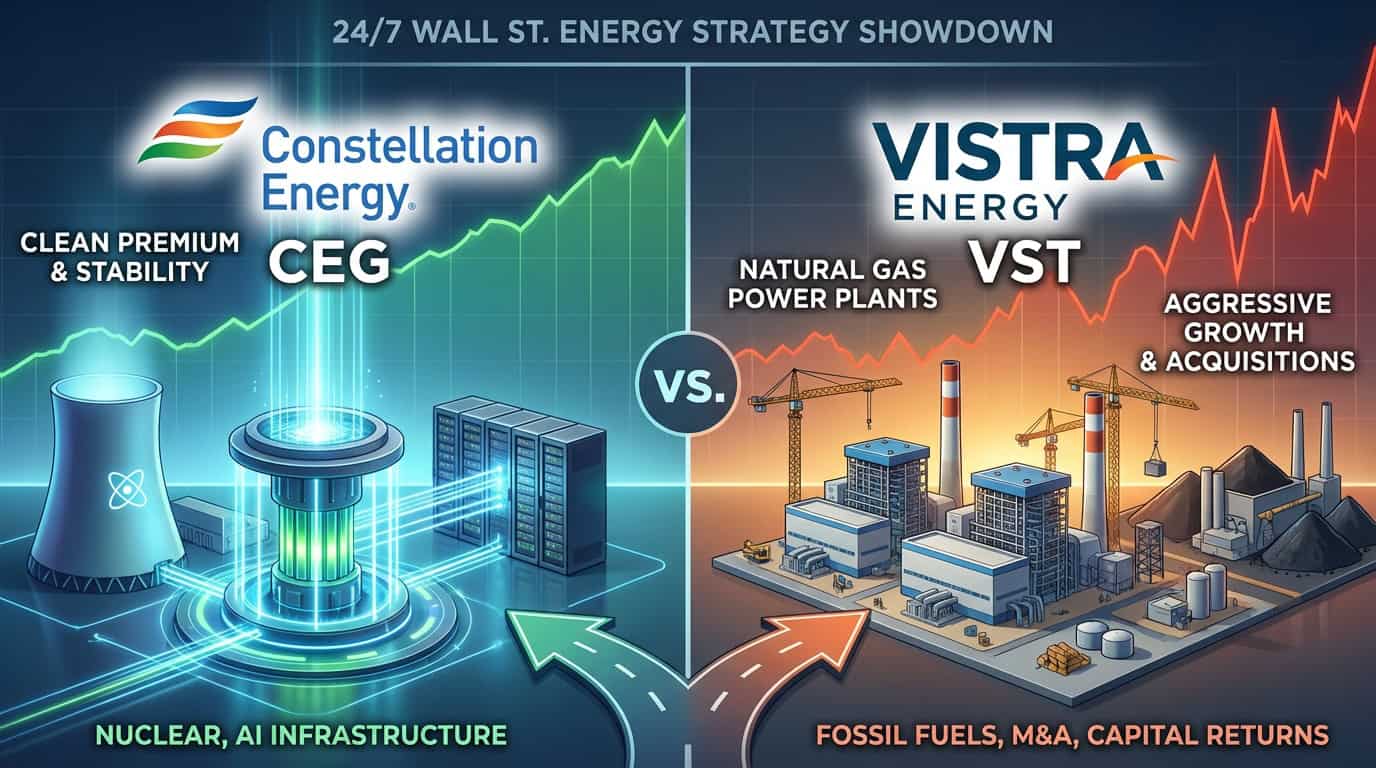
Constellation Energy and Vistra Energy reported Q3 earnings, revealing fundamentally different power generation strategies. Constellation focused on its premium nuclear assets and clean energy positioning, reporting increased nuclear production and improved renewable capture rates, aiming to be a reliable, carbon-free power backbone for data centers and AI workloads. Vistra, despite missing revenue estimates and seeing a year-over-year net income drop, pursued aggressive growth by acquiring seven natural gas plants, initiating construction of two new gas units, and securing a 20-year power purchase agreement for its Comanche Peak nuclear facility. The company also authorized an additional $1 billion in share repurchases. Constellation holds an 11% profit margin compared to Vistra's 6.7%, but Vistra's lower forward P/E and higher institutional ownership suggest market expectations of significant future earnings acceleration.
Background
Currently, electricity demand is experiencing an unprecedented surge driven by the rapid expansion of data centers and AI infrastructure. This presents significant opportunities for power producers and prompts them to explore diverse strategies to meet the growing demand. Constellation Energy and Vistra Energy are major players in the U.S. power market. Constellation is primarily known for its substantial nuclear assets and commitment to clean energy, aligning with the increasing demand for sustainable and reliable power. Meanwhile, Vistra pursues a more diversified strategy, including natural gas, nuclear, coal, solar, and storage assets, seeking growth through M&A and new builds. Against the backdrop of President Trump's re-election, U.S. energy policy is likely to continue supporting an "all-of-the-above" energy strategy, fostering both traditional fossil fuels and clean energy, which provides potential policy leeway for different types of power companies.
In-Depth AI Insights
What market revaluation does the divergent strategies of Constellation and Vistra signal in the current energy transition? - Constellation's focus on nuclear and clean energy positions it as an infrastructure backbone for high-demand industries like AI and data centers by providing stable, carbon-free baseload power. Its higher trailing (41.17x) and forward (32.15x) P/E ratios reflect market recognition of its asset quality, predictable cash flows, and a 'clean premium.' - Vistra, conversely, pursues growth through aggressive natural gas plant acquisitions and new builds. Despite a higher proportion of traditional fossil fuels, its forward P/E (17.92x) is significantly lower than Constellation's, with management forecasting substantial EBITDA growth in 2026. This indicates the market is betting on its ability to accelerate future earnings by expanding capacity to meet rapidly increasing short-term power demand. - This valuation gap highlights the trade-off in the energy market between 'clean stability' and 'diversified growth.' Both models benefit from AI-driven power demand surges, but long-term market preference will depend on the pace of energy transition, policy support, and which model more effectively captures growth while managing associated risks. Considering the Trump administration's energy policies, what potential opportunities and risks face Vistra's natural gas expansion strategy? - Opportunities: The Trump administration generally supports the fossil fuel industry, prioritizing energy independence and cost-effectiveness. Vistra's investments in natural gas plants could benefit from a relatively lenient regulatory environment and continued demand for natural gas as a 'bridge fuel.' Furthermore, natural gas generation offers flexibility in meeting peak loads and rapid response needs, which is crucial for grid stability, especially with increasing intermittent renewable sources. - Risks: Despite policy support, the global trend towards cleaner energy remains strong in the long run. If future policies or market sentiment shift towards stricter carbon emission limits, Vistra's natural gas assets could face stranding risks or higher operating costs. Additionally, natural gas price volatility could impact its profitability, particularly amid heightened geopolitical uncertainties. What market expectations are revealed by institutional investors' preference for Vistra (92.7% ownership)? - The significant institutional preference for Vistra, higher than Constellation's 85%, suggests professional money managers are more bullish on Vistra's growth trajectory and potential for valuation re-rating. - This preference likely stems from the expectation that Vistra, through M&A and new builds, can more rapidly scale capacity to meet the surging power demand from AI and data centers, leading to substantial earnings growth. Its lower forward P/E, contrasted with high growth expectations, might be perceived as an undervalued opportunity, with potential for multiple expansion if its growth strategy materializes. - Furthermore, institutions might view Vistra's diversified asset portfolio (including nuclear, solar, and storage) as offering greater flexibility and risk hedging capabilities, enabling it to adapt better to dynamic energy market changes.